📅 Updated August 5, 2026
Key Takeaways
- Weak shower water pressure has nine common fixes, and how to increase water pressure starts free: clean the showerhead, clear the restrictor, and open both shutoff valves fully.
- Start by checking whether it is low water pressure in the shower only or weak flow through the whole house. That one answer cuts the suspect list in half.
- Healthy shower water pressure starts at the main: a ten dollar gauge on an outside spigot should read between 40 and 80 PSI, with most homes happiest near 50 to 60.
- A clogged showerhead is the most common shower water pressure thief of all, and a vinegar soak fixes it for the cost of a plastic bag and a rubber band.
- Too much shower water pressure is a problem too: anything over 80 PSI erodes pipes and appliances, and code calls for a water pressure regulator to tame it.
Weak shower water pressure almost always has one of nine causes, and the fixes run from a free vinegar soak to a regulator adjustment, ranked easiest first below. Before touching anything, answer the one question that sorts every shower water pressure problem: is it just the shower, or is flow weak at every fixture in the house? Shower only points at the head, the restrictor, or that branch. Whole house points at valves, the regulator, a hidden leak, or the supply itself.
This guide covers how to increase water pressure in both cases, how to test what you are working with, and when the problem is the opposite one: too much.
Why Shower Water Pressure Drops
The suspects behind weak shower water pressure sort neatly by that first question. When it is low water pressure in the shower alone, the usual villain is buildup: Midlands water carries enough minerals to slowly plug showerhead nozzles and the small restrictor behind them, the same scale that coats a slow drain over the years. A clogged showerhead can lose half its flow before anyone thinks to blame it, and because the change is gradual, most people blame the house instead.
When the whole house runs weak, look upstream. A shutoff valve left partially closed after past work is the classic and costs nothing to fix. A failing water pressure regulator drags every fixture down at once. A hidden leak bleeds pressure while it soaks something you cannot see, and the meter test the EPA recommends rules that out in ninety seconds, with the full walkthrough in our water leak guide. And when weak flow is hot side only, the water heater or its shutoff valve is the suspect, since the cold side never passes through it.
One more pattern worth naming: shower water pressure that dropped suddenly on the same day for the whole street is the utility working on the mains, not your plumbing. A quick word with a neighbor before any wrench comes out has saved plenty of Sunday afternoons.
So the thirty second triage before anything else: run the kitchen faucet, an outside spigot, and the shower, and compare. Strong everywhere but the shower means low water pressure in the shower specifically, and fixes one, two, and six below are your lane. Weak everywhere means the problem is upstream, and fixes three, four, seven, and eight own it. Every minute of shower water pressure troubleshooting goes faster once you know which half of the ladder is yours.
The 9 Shower Water Pressure Fixes, Easiest First
Here is how to increase water pressure in the order a sensible person works: free fixes first, cheap parts second, professional calls last. Most homes never get past number three.
1. Soak the Showerhead in Vinegar
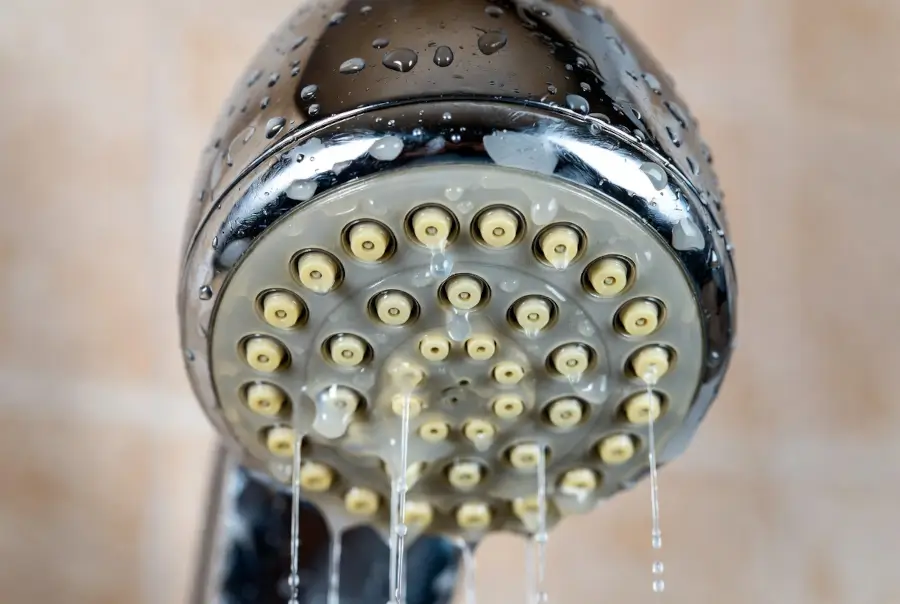
A clogged showerhead like this one steals shower water pressure one mineral deposit at a time.
Fill a plastic bag with equal parts white vinegar and water, wrap it around the showerhead so the nozzles are submerged, and rubber band it in place for a few hours or overnight. The vinegar dissolves the mineral scale plugging the openings. Take the bag off, run the shower hot for a minute to flush loosened debris, and scrub any stubborn nozzles with an old toothbrush.
Rubber nozzle heads respond to a thumb rub too: flexing each nozzle cracks the scale loose. For heads too crusted to save after one soak, repeat overnight before giving up on them, since thick scale dissolves in layers. If the spray pattern comes back strong, a clogged showerhead was your whole problem, and the shower water pressure you missed was hiding behind scale the entire time.
2. Clear the Flow Restrictor
Behind the showerhead face sits a small flow restrictor, there because federal law caps showerheads at 2.5 gallons per minute. Scale loves to collect on it, and a blocked restrictor mimics a clogged showerhead symptom for symptom. Unscrew the head, find the small plastic disc or screen, and clean it the same vinegar way rather than removing it: the restrictor is required equipment, and a clean one flows the way the engineers intended. If yours is damaged, replacing the head costs less than fighting it.
3. Open Both Shutoff Valves All the Way
Every home has a main shutoff where the line enters the house, and a second valve at the meter. Either one left partially closed strangles the whole system, and it happens more than anyone admits, usually after a repair or a vacation. A lever handle should sit parallel to the pipe. A round gate valve should be turned gently counterclockwise until it stops. If your shower water pressure jumps the moment a valve opens fully, you just fixed the house for free.
4. Rule Out the Meter Valve at the Street
The valve on the utility side of the meter can also sit partially closed after utility work. Check the position the same way. If it looks wrong and will not move easily, call the utility rather than forcing it, since that side of the meter belongs to them. Notes from the field: this one shows up after neighborhood main repairs, when crews restore service in a hurry and shower water pressure comes back wrong at half the houses on the block.
5. Stagger the Water Hogs
A shower taken while the washing machine fills and the irrigation runs is competing for the same supply. If shower water pressure is fine at ten at night and weak at seven in the morning, demand is your issue, not plumbing. The free fix is scheduling. If the house truly cannot run two fixtures at once even with everything else healthy, that points back to a supply restriction worth a professional look.
6. Upgrade the Showerhead Itself
Sometimes the head is simply old, corroded inside, or cheaply made. Replacements with the EPA WaterSense label are worth knowing about here, because the label is a performance certification, not just an efficiency one: labeled heads must prove spray force and coverage across a range of pressures. Translation for a weak pressure house: a WaterSense head at 2.0 gallons per minute is engineered to feel strong at pressures where a bargain 2.5 head feels like a dribble. For an older head on a healthy supply, this swap is the cheapest jump in shower water pressure most homes ever feel.
7. Put a Number on It: The Gauge Test
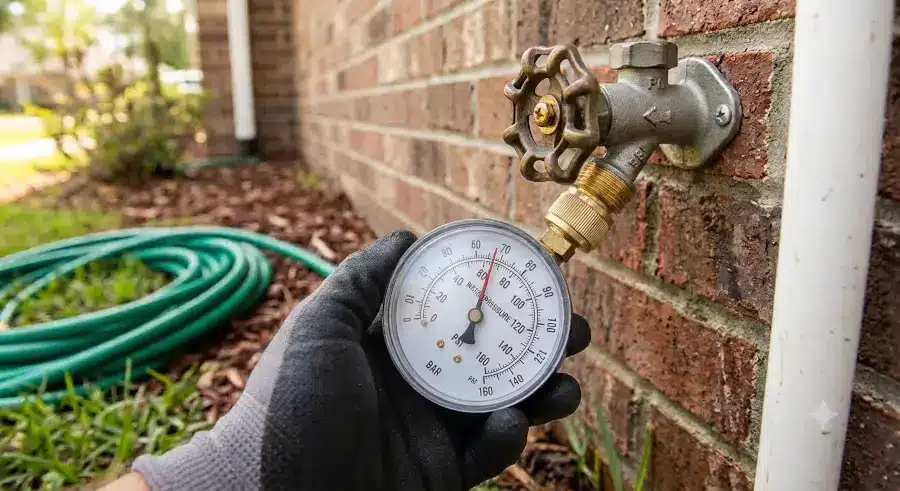
The gauge test: thread it on an outside spigot, open the valve, and healthy shower water pressure at the source reads 40 to 80 PSI.
Everything above this line was guessing politely. A ten dollar pressure gauge from any hardware store threads onto an outside spigot, and with the spigot opened, reads your home’s static pressure in seconds. This is the first thing we do on every pressure call, before anything gets touched, because the number decides everything: 40 to 80 PSI is the healthy band, 50 to 60 is where most homes feel best, below 40 means the supply or regulator needs attention, and above 80 is its own problem covered further down.
Two habits make the reading trustworthy. Take it with no other water running anywhere in the house, because a filling washing machine drags the number down and lies to you. And take it twice at different times of day, since municipal pressure breathes with neighborhood demand: a home reading 55 at noon can read 70 at midnight. We note both numbers on every pressure call, because the spread tells its own story about what the house lives with.
Shower water pressure by the numbers:
8. Check the Water Pressure Regulator
The water pressure regulator is the bell shaped brass fitting near where the main enters the house, and it exists to hold street pressure down to a number your pipes can live with. Regulators wear out in ten to fifteen years, and a failing one can drift low, drift high, or swing unpredictably. If your gauge test reads low and the valves are all open, the regulator is the prime suspect. Adjustment is a small job done right, but it is a job with consequences done wrong, which is why we put it on the professional side of the line below.
9. Bring In the Trace
If the gauge reads healthy and the house still underperforms, something between the main and your showerhead is stealing flow: a hidden leak, a crushed or corroded line, or mineral choked pipe in an older home. That is trace work, the same professional maintenance visit that catches small problems while they are small. And for the rare Midlands home on a chronically weak supply, a whole house booster pump is the legitimate fix: a small pressure tank and pump that lifts the entire system, sized and installed to code. That is the American answer to weak supply, and it is a quote before work begins job like everything else here.
One note for the Midlands housing stock specifically: homes built before the mid 1970s that still carry original steel supply lines often have weak flow no ladder can fix, because decades of internal rust have narrowed the pipe itself. The tell is pressure that tests healthy at the spigot but dies at every fixture, worse on hot. That conversation is about the pipes, not the showerhead, and it deserves honest numbers rather than another gadget.
The whole ladder on one card, with honest time estimates:
Worked the Ladder and Still Showering in a Drizzle?
Tanya answers the phone, Manny brings the gauge, and the exact price is quoted in writing before any work begins.
Hot Water Weak, Cold Water Fine? Read This First
A special case worth its own minute: shower water pressure that collapses only when the mix runs hot. Cold water never touches your water heater, so hot only weakness points straight at it: a partially closed inlet valve on top of the tank, sediment buildup narrowing the outlet, or in older tanks, a failing dip tube. The quick check is any hot faucet in the house: if the kitchen sink runs weak on hot too, the heater is your suspect, not the shower.
The inlet valve check is homeowner territory: the valve on the cold line feeding the tank should be fully open, and it gets bumped more often than anyone expects. Sediment and dip tube work belong to a pro, and both are routine visits: a tank flush is annual maintenance money, and a dip tube swap costs far less than the new water heater people fear. Either way, low water pressure in the shower that is really a hot side problem never gets fixed at the showerhead, which is why the triage question always comes first.
When Shower Water Pressure Is Too High
The first article this site ever published, back in 2016, was about the opposite problem. That little post served for a decade, and its subject retires into this section rather than disappearing, because it deserves the space because too much pressure is quieter and more expensive than too little. Anything above 80 PSI is out of bounds: it erodes pipe from the inside, batters appliance valves, springs leaks at faucets and toilets, and inflates the water bill with every use. Plumbing code handles it plainly, calling for a water pressure regulator when supply exceeds 80.
The tells of a high pressure house: banging pipes when valves close, faucets that spray violently, appliances that fail young, and a gauge test reading in the red. If that describes yours, a water pressure regulator install or adjustment is a modest job that protects everything downstream of it, and the shower feels better afterward too, because steady correct shower water pressure beats wild pressure every time, at the showerhead and at every appliance behind it.
Your House or the City?
One Columbia area reality check before anyone spends money: pressure at your home depends partly on where you sit on the utility’s system. Homes on high ground, at the far end of a main, or in neighborhoods with aging distribution lines can run lower than the house down the hill, and no showerhead fixes geography. The two minute investigation: ask a neighbor whether their pressure matches yours. Shared weakness points at the supply side and a call to the utility. Yours alone points back at this page’s ladder, and the gauge test tells you which rung.
That is also the honest frame for how to increase water pressure sustainably: fix what is yours, verify what is theirs, and size any upgrade, from showerhead to booster pump, to the pressure your home truly receives. West Columbia, Cayce, and the neighborhoods around Lake Murray all sit at different points on different systems, and the same house plan can shower differently on each.
The gauge does not care about any of that; it just reports your number, which is why every shower water pressure decision starts there. Guesswork is the only approach that costs more than it returns.
Get the Shower You Have Been Rationing
Weak shower water pressure is one of those problems people quietly live with for years, and it is usually one vinegar soak, one valve, or one regulator away from solved. That ladder is how to increase water pressure without wasting a dollar: work it top to bottom, let the gauge referee, and when the house needs more than a homeowner fix, that is what we are for. Nobody should ration shower water pressure in a house they own, and after nearly three decades of these calls, the fix has been simpler than the homeowner expected far more often than not.
Tanya answers, Manny has chased weak pressure through Midlands homes for over 28 years, and diagnosing it right the first time is part of the plumbing services promise: exact price in writing before any work begins.
Restoring shower water pressure starts with a gauge and ends with a shower worth looking forward to.
Ready for a Real Shower Again?
Family and veteran owned. Licensed, bonded, and insured. Military and senior discounts.
Shower Water Pressure Questions Columbia Homeowners Ask Us
These are the pressure questions we hear most on Midlands service calls. If yours is not answered here, call the office and Tanya will get you a straight answer.
What is normal shower water pressure?
Healthy shower water pressure comes from a supply running 40 to 80 PSI at the main, and most homes feel best around 50 to 60. Below 40 feels weak everywhere, and above 80 damages pipes and appliances over time. A ten dollar gauge on an outside spigot tells you your number in about two minutes.
Why is my shower water pressure suddenly low?
Sudden drops usually mean a valve, not buildup. Check that the main shutoff and meter valves are fully open, ask a neighbor whether their pressure fell too, and rule out a hidden leak with the meter test. Gradual decline points at mineral scale instead, and the vinegar soak is the first move there.
Why do I have low water pressure in the shower but nowhere else?
When it is low water pressure in the shower alone, the problem lives at that fixture: a scale clogged showerhead, a blocked flow restrictor, or a failing shower valve behind the wall. The vinegar soak and restrictor cleaning solve most cases. If both fail, the shower valve itself deserves a professional look.
Does a bigger showerhead increase water pressure?
No, and it often feels weaker. Pressure is supplied by the house; a larger head spreads the same flow across more nozzles. If strong spray is the goal, a WaterSense labeled head is the smarter buy, since the label requires proven spray force and coverage even at lower flow. Fix supply first, then choose the head.
Can I remove the flow restrictor from my showerhead?
We recommend cleaning it, not removing it. The restrictor is required under the federal 2.5 gallon per minute showerhead standard, and a clean one flows the way the head was engineered to perform. If yours is scaled beyond saving, a new WaterSense head delivers strong spray legally and permanently.
How do I test my home's water pressure?
Thread an inexpensive pressure gauge onto an outside spigot, open the spigot fully with no other water running, and read the dial. That is your static pressure. In the 40 to 80 PSI band, the supply is healthy and any weakness is at the fixtures. Outside that band, the regulator is the next stop.
When do I need a water pressure regulator?
Whenever the gauge reads above 80 PSI, code expects one, and your pipes will thank you for it. You also need attention to an existing regulator when pressure drifts low or swings, since regulators wear out in ten to fifteen years. Adjustment and replacement are both quick professional jobs, quoted before work begins.