📅 Updated August 4, 2026
Key Takeaways
- The six signs that you have a gas leak: a rotten egg smell, hissing sounds, dying plants, fog or bubbling ground, a higher gas bill, and physical symptoms.
- If you smell gas, leave the house on foot first, then call 911 and Dominion Energy at 800-815-0083 from a safe distance. Do not flip a single switch on your way out.
- Wondering what does a gas leak smell like? Rotten eggs. Natural gas is odorless, so utilities add mercaptan to make every leak announce itself.
- Gas line installation in South Carolina requires a permit, an 811 locate three working days before digging, and a licensed gas fitter.
- Everyday gas leak safety comes down to two habits: working detectors in the house and a yearly service check on gas appliances.
The clearest signs that you have a gas leak are a rotten egg smell, a hissing sound near a line or appliance, dying plants along the pipe path, fog or bubbling at ground level, a gas bill that climbed for no reason, and headaches or dizziness that fade when you step outside. One sign deserves attention. Two or more deserve action. This guide walks through all six in detail, what to do the moment you suspect a leak, and how proper installation and a little gas leak safety prevent the problem in the first place.
Smell Gas Right Now? Do This First
Leave the house on foot immediately. Do not touch light switches, phones, or appliances on your way out. From a safe distance, call 911, then Dominion Energy South Carolina at 800-815-0083. Both lines answer around the clock. Come back to this article after everyone is out and the call is made.
What Does a Gas Leak Smell Like?
Rotten eggs, sulfur, or a skunk. If you have ever typed what does a gas leak smell like into a search bar, that is the whole answer, and the smell is deliberately hard to miss. Natural gas is colorless and odorless in its raw state, so utilities add a chemical odorant called mercaptan before it ever reaches your meter. The federal pipeline safety agency PHMSA describes mercaptan as a harmless, non toxic additive with a skunk like odor that exists purely so your nose can catch a leak early.
Two smell notes worth knowing. First, the odor can be faint with a small leak, so do not dismiss a whiff just because it fades. Second, not every rotten egg smell is natural gas. A dry floor drain or a failed trap can push sewer gas into the house with a similar stink. Our guide to sewage smells in the house covers that lane.
People also ask what does a gas leak smell like outdoors: the same odor, just fainter and scattered by wind, which makes it easier to dismiss and worth taking just as seriously. The difference matters, but when in doubt, treat it as gas and get out first. Sorting it out from the driveway costs nothing.
The 6 Signs That You Have a Gas Leak
Here are the six signs of a gas leak in the order we usually hear about them from Midlands homeowners, from the obvious to the sneaky. The first two demand an immediate exit. The rest buy you time to investigate properly.
1. The Rotten Egg Smell
The odorant does its job. If the smell is strongest near the stove, the water heater closet, the furnace, or the outside meter, take it seriously and follow the steps in the red box above. A smell that appears when an appliance kicks on and fades when it shuts off points at that appliance’s connection, which narrows the search for whoever makes the repair. Of all the signs of a gas leak, this is the one engineered on purpose to reach you first.
2. Hissing or Roaring Sounds
Escaping gas makes noise, anywhere from a soft hiss to a steady roar depending on the size of the opening. If you can hear a leak at all, it is already substantial. A hiss near a gas line, a flex connector, or the meter is not a wait and see situation. Leave first and make the calls. Sound is the one sign that skips the diagnosis stage entirely.
3. Plants Dying for No Reason
Gas leaking from a buried line pushes oxygen out of the soil, and the grass or shrubs above it quietly suffocate. A stripe of brown lawn over the gas service path, or one dead patch in an otherwise healthy bed, is the classic signature of an underground leak. Plants die for plenty of innocent reasons, but a dead zone that traces a line across the yard is one of the surest signs of a gas leak underground.
4. Fog, Mist, or Bubbling at the Ground
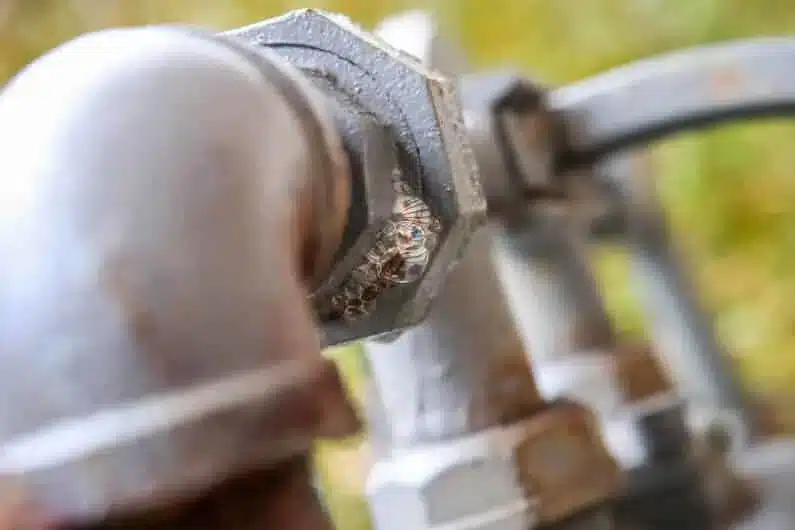
Bubbling at a fitting is one of the plainest signs of a gas leak, and the same principle powers the soap test pros use.
A ruptured line can create a faint fog or vapor cloud near the ground, and escaping gas will bubble up through puddles, wet soil, or standing water. Blowing dirt around a line with no wind to explain it belongs in the same family. The photo above shows the visual worth remembering: bubbles forming at a fitting mean gas is finding its way out. Pros confirm suspect joints the same way, with a gauge and a leak detection solution that bubbles at the escape point.
5. A Gas Bill That Jumped Without a Reason
Small leaks can run silently for months, and the meter bills every cubic foot that escapes. If your usage climbed and nothing changed, no new appliance, no houseguests, no cold snap, a slow leak is one of the possible explanations. Pull your last few statements and compare the same months year over year. A steady unexplained rise is one of the quieter signs of a gas leak, and it is the one your budget notices first.
6. Headaches, Dizziness, or Fatigue That Clears Outside
Displaced oxygen shows up in people too. Persistent headaches, drowsiness, dizziness, nausea, or trouble breathing that improve when you leave the house are a pattern worth taking seriously, especially if more than one person in the home feels it. Pets often act off first. None of these symptoms proves a leak on its own, but among the signs of a gas leak, this is the one that involves your family directly. Paired with anything else on this list, get everyone out and make the calls before you investigate anything.
The quick reference version of the signs of a gas leak, all six on one card:
A word on false alarms, because they are common and nothing to be embarrassed about. Cooking with onions or garlic, a dry floor drain, a whiff of skunk through an open window, and mulch decomposing against the foundation can each mimic one of the signs of a gas leak for a moment. The difference is persistence and pattern. A smell that lingers, returns to the same spot, or pairs with a second sign has separated itself from coincidence. And again: the utility would rather check a false alarm than miss a real one.
What Not to Do If You Suspect a Leak
The leave first rule exists because almost everything you would instinctively do on the way out can create a spark. Per Dominion Energy’s gas line safety guidance, do not flip light switches on or off, do not use your phone until you are outside, do not open the garage with the opener, do not start a car in an attached garage, and do not ring anyone’s doorbell to warn them. Knock with your hand instead.
Two more that surprise people. Do not hunt for the source of the smell, and do not try to operate gas valves yourself. Turning the wrong valve can route more gas toward the leak, and every minute spent searching is a minute spent inside the one place you should not be. The utility checks for leaks at no charge and would far rather roll a truck for a false alarm than the alternative. Nobody involved will ever fault you for calling.
Why Gas Leaks Happen in the First Place
Most residential leaks trace to a short list of causes. Aging flexible appliance connectors give out, especially the older styles. Fittings loosen from decades of vibration and thermal cycling. Corrosion works on buried or exposed steel pipe. Appliances get installed or moved by someone who was not licensed for gas work, and the connection is wrong from day one. And shovels find unmarked lines, which is why the locate call exists. Most of the gas leak safety battle is won by keeping those ordinary causes maintained instead of ignored.
The Midlands adds a local wrinkle: our clay heavy soil swells when saturated and shrinks hard in drought, and decades of that movement works on buried steel service lines and their fittings. It is part of why the dead vegetation stripe shows up here more than homeowners expect, and why any digging project, even a mailbox post, gets the 811 call first. Soil movement is slow, patient, and completely indifferent to what it bends.
One cause specific to newer homes is worth naming: CSST, the yellow flexible gas tubing common since the 1990s, must be bonded to the home’s electrical grounding system under the SC Building Code. Unbonded CSST can be perforated by a nearby lightning strike. If your home has yellow gas tubing and nobody has ever confirmed the bonding, that check belongs on your list.
Leak Handled and the House Is Safe? Get It Repaired Right
Once the utility has made things safe, Tanya can get your repair on the schedule with a Master Gas Fitter, with the exact price quoted before any work begins.
Gas Line Installation Done Right
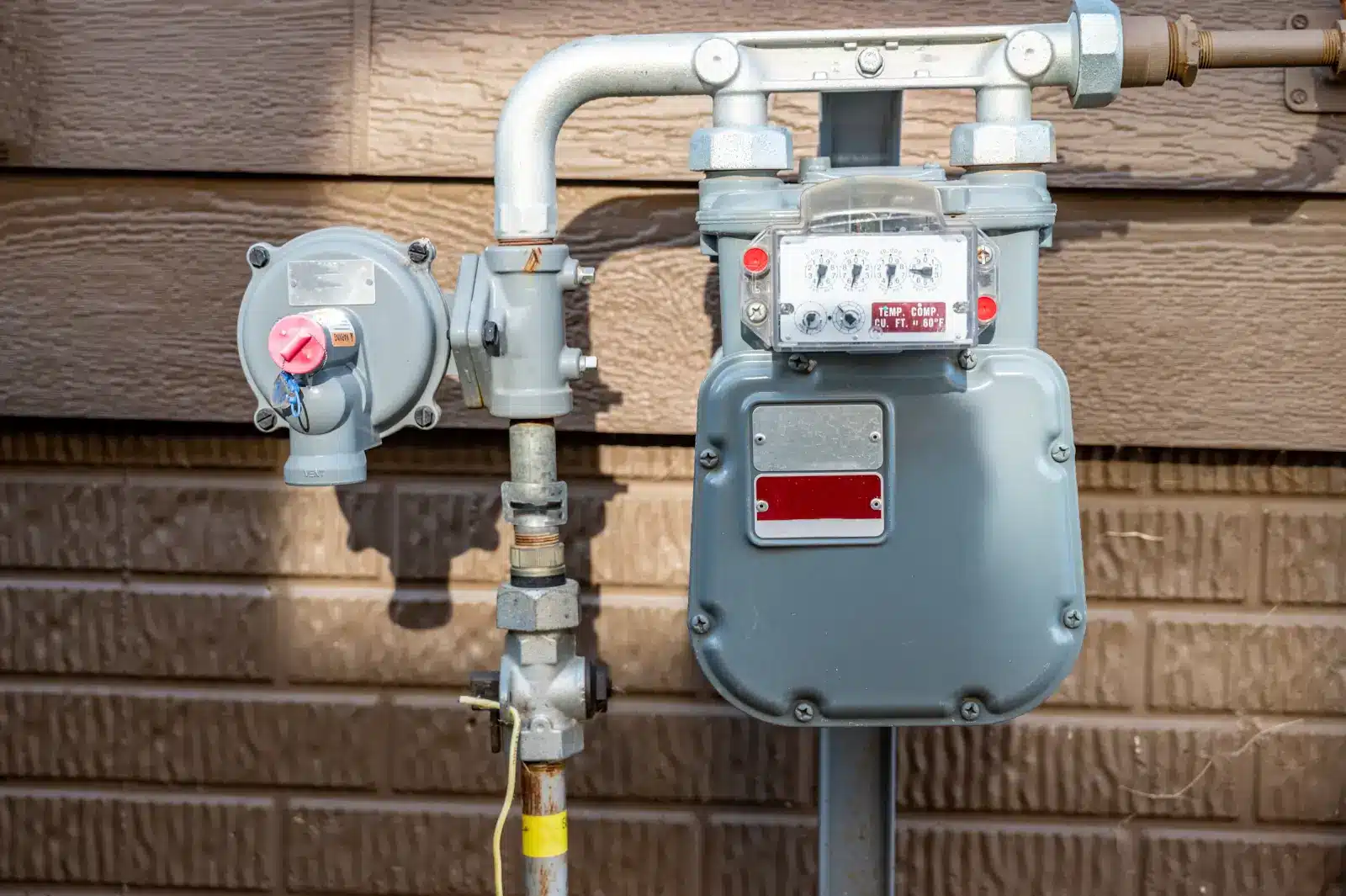
Gas line installation starts at the meter: the utility owns everything before it, and the homeowner owns everything after.
Prevention starts with how the line went in. The meter in the photo is the property line of responsibility: the utility owns and maintains everything up to it, and everything downstream, the house piping, the connectors, the appliance hookups, belongs to the homeowner. That is the side where proper gas line installation earns its keep for decades, and the side where shortcuts eventually announce themselves as one of the six signs above.
Done right in South Carolina, gas line installation means a permit and inspection, correctly sized black iron pipe or properly bonded CSST, a drip leg at appliance connections, and a licensed gas fitter doing the work. It also means calling 811 before any digging: state law requires the locate request at least three full working days before excavation, and SC811 marks the buried utilities at no cost.
Here is the habit that separates the pros: when we set or repair a line, every joint gets pressure tested with a gauge and checked with leak solution, the same bubble principle in the photo further up, before gas ever flows. The test costs minutes. Skipping it costs trust.
Everyday Gas Leak Safety at Home
Between installation day and any future problem, gas leak safety is mostly two habits. The first is detection you do not have to think about: a natural gas detector near gas appliances and carbon monoxide detectors on every sleeping level. Your nose works, but it does not work while you sleep, and it adapts to faint smells faster than most people expect. Detectors do not.
Placement matters more than brand. Natural gas rises, so gas detectors mount high, within a foot of the ceiling, in the rooms that hold gas appliances. Carbon monoxide mixes with room air, so CO detectors go at breathing height near sleeping areas. Test both monthly, replace batteries on a schedule, and swap the units at the age printed on the back. Ten dollars of battery is the cheapest gas leak safety money can buy.
The second habit is annual service on gas appliances. A yearly check catches deteriorating connectors, drifting burners, and blocked venting while they are still maintenance items instead of leak sources. Between visits, glance at your burner flames now and then: steady blue is healthy, while lazy yellow or orange flames on a furnace or water heater mean the appliance needs attention. And keep the area around your outside meter clear so the utility can reach it and damage cannot sneak up on it.
Who Handles What: The Utility, Then the Gas Fitter
The division of labor is simple once you see it. During a suspected leak, the utility and 911 own the emergency: they respond around the clock, make the scene safe, and shut off what needs shutting off. The repair that follows is where a licensed professional on the homeowner side comes in, whether that is a failed connector, a corroded run, or a line that needs to be rerouted or replaced entirely.
One note for renters: you have the same right to a safe house as any owner. Report any of the signs of a gas leak to 911 and the utility yourself, immediately, and inform the landlord afterward. Leak response never waits on a property manager’s office hours, and no lease clause outranks it.
That second half is licensed territory for a reason. Manny Anderson holds SC Master Gas Fitter license No. 001140508 alongside his Master Plumber license, both verifiable at the state LLR site linked in our footer, and gas work at Plumb Time is handled under that license with the price quoted in writing before any work begins. It is one part of the plumbing services we have provided to Midlands homes for over 28 years, and the part where cutting corners is simply not on the menu. Gas leak safety does not end when the utility truck leaves, and a repair is not finished here until the gauge says so.
Trust Your Nose, Then Trust the Process
The six signs of a gas leak above catch nearly every residential case before it becomes a story. If one of them shows up at your house, the gas leak safety playbook never changes: leave first, call 911 and Dominion from outside, let them make it safe, and then get the repair done properly by someone licensed to do it. Tanya answers the phone, the quote comes in writing, and the work gets pressure tested before we call it finished.
Gas leak safety ends the same way it starts: with the job checked, tested, and done right.
Need a Gas Repair Done Right?
Master Gas Fitter licensed. Family and veteran owned. Exact price quoted before any work begins.
Gas Leak Questions Columbia Homeowners Ask Us
These are the gas questions we hear most from Midlands homeowners. If yours is not answered here, call the office and Tanya will get you a straight answer.
What does a gas leak smell like?
Rotten eggs, sulfur, or skunk. Natural gas has no odor of its own, so utilities add a chemical called mercaptan specifically so leaks announce themselves to your nose. If you notice that smell indoors, leave the house on foot without touching switches and call 911 and your gas utility from a safe distance.
What should I do first if I smell gas in my house?
Leave immediately, on foot, without flipping any switches or using your phone inside. From a safe distance, call 911 and then Dominion Energy South Carolina at 800-815-0083. Both answer around the clock and the leak check costs nothing. Never search for the source or touch gas valves on the way out.
Can a gas leak make me sick?
Yes. Leaking gas displaces oxygen indoors, which can cause headaches, dizziness, drowsiness, nausea, and trouble breathing. The tell is symptoms that ease when you go outside, especially when several people or pets in the home feel off at once. Get everyone out first, then make the calls from a safe spot.
Who do I call for a gas leak, the utility or a plumber?
The utility first, every time. Dominion Energy and 911 handle the emergency around the clock and make the scene safe at no charge. The repair that follows is licensed gas fitter work: failed connectors, corroded lines, and bad hookups. That is where we come in, with the price quoted before work begins.
Can I check for a gas leak myself?
Only in a limited way, and never during an active smell. On an accessible fitting with no gas odor present, soapy water brushed on a joint will bubble at a leak point. Anything beyond that, opening lines, testing pressure, or repairs, is licensed work. If you smell gas, skip every test and leave the house.
How much does gas line installation or repair cost?
It depends entirely on the run length, material, access, and permits involved, so we do not publish blanket figures. What we promise instead: an inspection first, then the exact price in writing before any work begins. No surprises on the invoice is a rule here, not a slogan, and it applies to every gas job.
What does South Carolina require for gas line installation?
A permit with inspection, a licensed gas fitter performing the work, and an 811 utility locate at least three full working days before any digging. Materials must meet code, including bonding for CSST flexible tubing. It is one of the most regulated jobs in a house, and for good reason: done right, it stays boring.