📅 Updated August 3, 2026
Key Takeaways
- What is hydro jetting? A cleaning method that uses high pressure water, delivered through a specialized nozzle, to scrub drain and sewer pipes back to their full open diameter.
- Forward jets cut through the blockage while reverse jets drive the hose deeper and flush debris out of the line, so nothing gets left behind on the pipe walls.
- You need it when clogs keep returning, when grease or roots have claimed a line, or when a cable clears a path that closes right back up.
- A camera inspection before and after protects the pipe: sound lines get jetted, damaged lines get repaired instead.
- Answering what is hydro jetting for your own home starts with one call, and the price always comes before the work.
What is hydro jetting? It is the deepest cleaning a drain or sewer pipe can get: high pressure water, shaped by a specialized nozzle, scrubbing the entire inside surface of the line until grease, roots, scale, and sludge are flushed out instead of merely punched through. Where a drain snake bores a hole in a clog, hydro jetting removes the buildup itself, wall to wall, which is why the results last years instead of weeks.
This guide answers what is hydro jetting in plain language: how the equipment works, what the process looks like on a real visit, when your pipes need it, and just as important, when they do not. Questions along the way? Call (803) 988-9202.
The 15 second version: what is hydro jetting? Professional pipe cleaning with high pressure water that strips buildup off the walls and flushes it away, restoring the line to full flow. If you remember one thing about what is hydro jetting, make it this: cables open clogs, water removes them.
What Is Hydro Jetting?
Hydro jetting is a professional pipe cleaning method that sends water through a flexible high pressure hose to a nozzle engineered for one job: restoring a pipe to its original working diameter. The water does everything. No blades scrape the pipe, no chemicals burn through the clog, and nothing gets left behind to seed the next blockage. That distinction is the whole answer to what is hydro jetting versus everything else in the drain cleaning toolbox.
The method earns its keep on the buildup other tools cannot touch. Years of cooking grease cooled onto kitchen line walls. Mineral scale narrowing old cast iron. Sludge settled in the low spots of a sewer run. Tree roots matted across a clay joint. A cable passes through all of these and leaves most of the material in place. High pressure water strips them off the wall and carries them down the line to the sewer main, where they belong.
The equipment is a different class from anything at a rental counter. A jetting rig pairs a high volume pump with hundreds of feet of hose and a case of task specific nozzles: penetrating heads for solid clogs, rotating heads for grease, root cutting heads for intrusions. Matching the nozzle and the pressure to the pipe is the professional’s half of the answer to what is hydro jetting done right.
What Hydro Jetting Is Not
Half of answering what is hydro jetting is clearing up what it is not, because the name invites some expensive misunderstandings. It is not a pressure washer on a longer hose. A big box pressure washer tops out around 2,000 to 3,000 psi with a fraction of the water volume, no propulsion nozzle, and no way to travel a buried line. People who ask what is hydro jetting after trying the driveway machine on a floor drain usually ask from experience.
It is not a chemical treatment either. No caustics, no enzymes, nothing left in the pipe but the water itself, which is exactly why plumbers reach for it on lines that chemical drain openers have already failed. And it is not pipe repair. Jetting cleans what exists; it cannot mend a crack, lift a belly, or rejoin an offset. When people research what is hydro jetting hoping it fixes a broken line, the camera has to deliver the honest news that cleaning and repairing are different trades on the same truck.
Finally, it is not always the answer, and any company that jets every clog is selling equipment time rather than solving problems. A first time blockage at one fixture needs a cable, not a rig. The what is hydro jetting question matters precisely because the method is specialized: spectacular on buildup, wasted on simple clogs, and wrong on damaged pipe. Knowing which situation is yours is the whole game, and the next sections show how the pros tell the difference.
How Does Hydro Jetting Work?
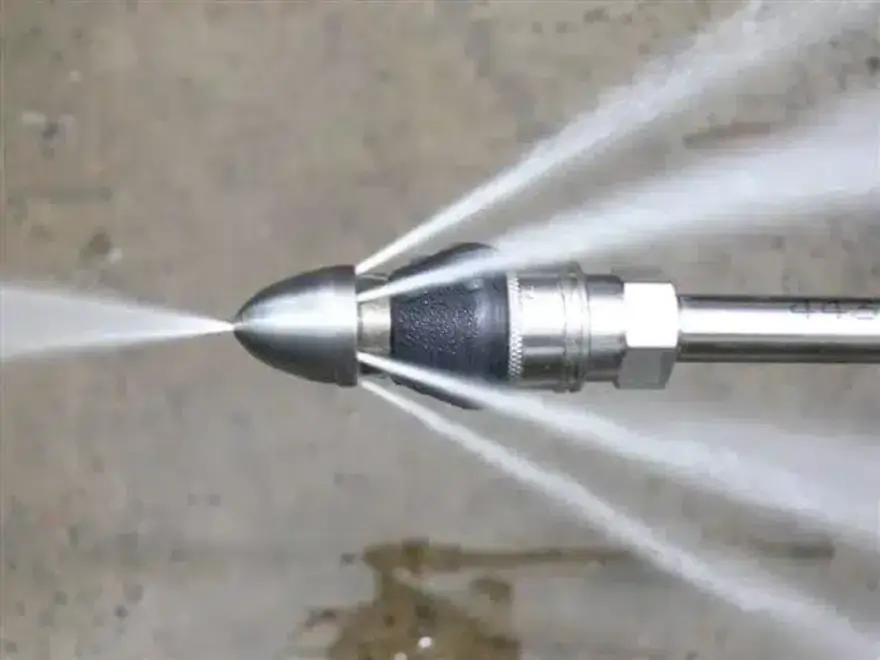
The physics fit in one sentence: water leaves the nozzle in two directions at once. Forward jets fire ahead of the nozzle to cut into the blockage. Reverse jets angle backward, and they do double duty, propelling the hose deeper into the line like a small rocket while flushing every loosened piece of debris back down the pipe behind it. The nozzle pulls itself through the system, cleaning as it travels, and the operator controls the pace from the access point. That self-propelled scrubbing is the mechanical heart of what is hydro jetting.
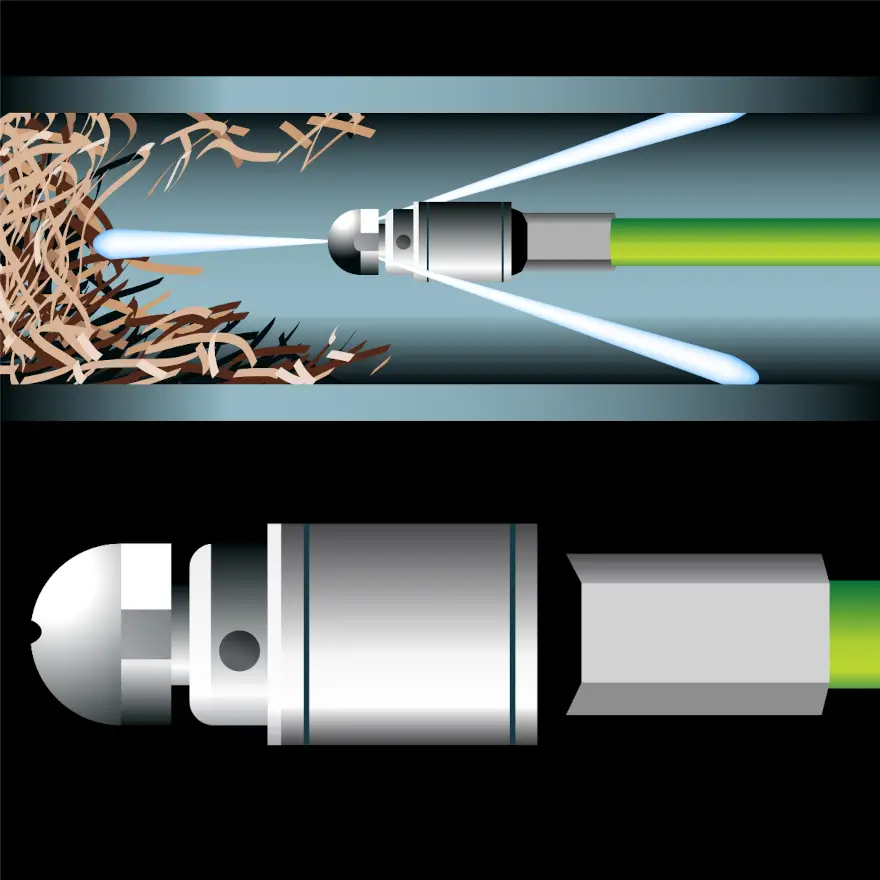
Forward jets cut, rear jets propel and flush. That is how does hydro jetting work in one picture.
Pressure is the tuned variable, not a fixed number. Most residential sewer work runs between 1,500 and 4,000 psi, with commercial rigs able to push beyond that when a line calls for it, and the right setting depends on what the pipe is made of. Cast iron under heavy scale takes a different pressure and nozzle than PVC with a grease problem, and older clay tolerates less than either. More pressure is never automatically better. The correct pressure for the pipe in front of you is.
Water volume matters as much as pressure. The gallons per minute moving through the line are what carry the loosened debris away, which is why a jetting rig cleans a pipe that a pressure washer with similar psi never could. Cutting the buildup loose is half the job. Flushing it out of your plumbing entirely is the half that makes the cleaning last.
The Hydro Jetting Process From First Call to Clean Line
Every professional hydro jetting process should start with eyes on the pipe, not water in it. A sewer camera inspection runs the line first to answer three questions: what the pipe is made of, where and what the blockage is, and whether the line is structurally sound enough to jet at all. A cracked or collapsing pipe should never be jetted, and the camera is what catches that before high pressure water finds the weak spot the hard way.
With the line cleared for cleaning, the hose enters through a cleanout and the operator works the nozzle through the run, letting the jets strip the walls as they travel. Heavy grease and root mats get multiple passes, sometimes with a nozzle change between them. Most residential jobs finish in one to three hours.
The hydro jetting process ends the way it began: with the camera. A verification pass shows the cleaned pipe on screen, wall to wall, so the proof of the work is footage rather than a promise. If you have never watched a before and after of a jetted line, it is the most satisfying thing in plumbing.
When Do You Need Hydro Jetting?
Knowing what is hydro jetting only helps if you know when to use it. Not every clog earns the big rig, so when do you need hydro jetting instead of a simpler fix? The honest answer lives in the history of the line more than in any single backup. These are the three situations that call for it.
1. The Same Clog Keeps Coming Back
A one time blockage is an event, and a cable handles events well. A drain that slows again within weeks of every clearing is a pattern, and patterns mean buildup the cable is drilling through and leaving behind. Grease lines are the classic case: the cable opens a channel, the grease closes it, and the cycle repeats until someone removes the grease itself. If you are paying to clear the same line for the third time, our guide on clearing a main sewer line clog explains why the pattern persists, and jetting is usually how it ends.
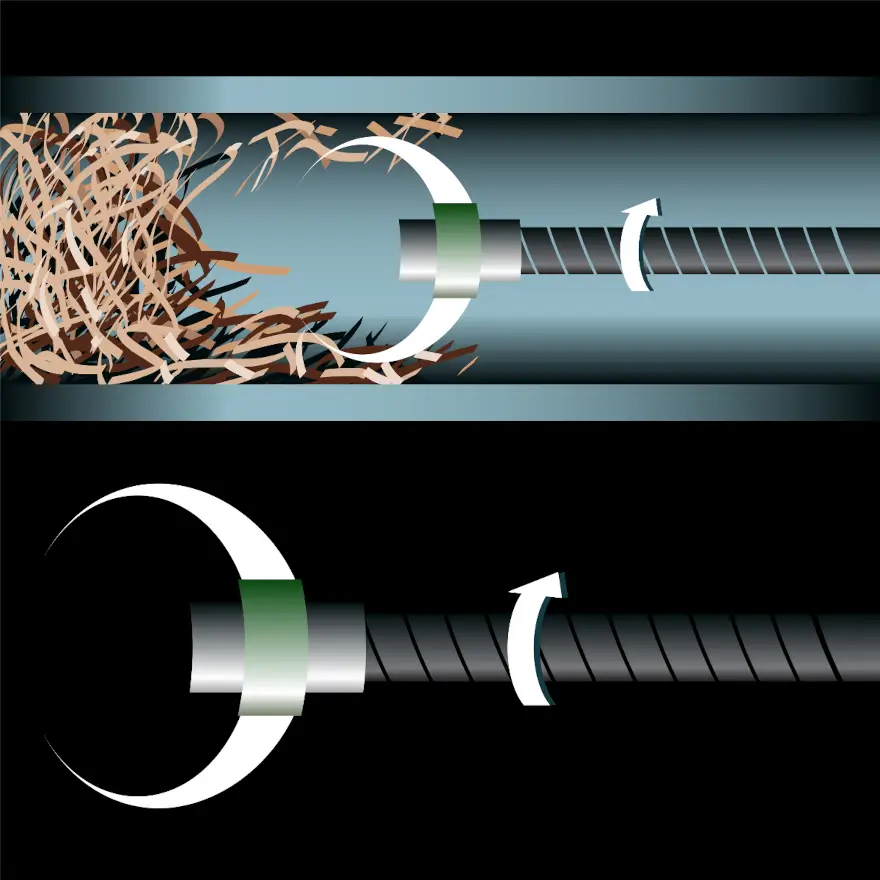
A cable bores a path through the clog and leaves the rest on the walls. Water removes it all.
2. Roots or Heavy Buildup Have Claimed the Line
Tree roots enter sewer pipes through joints and grow into mats that catch everything the line carries. Root cutting nozzles sever the intrusion and flush the debris in the same pass, more thoroughly than any cable can manage inside a pipe. The same goes for lines coated in years of scale or sludge: once buildup owns the walls, cleaning the walls is the only fix that holds, and that is exactly the job high pressure water was built for. Deeper background lives in our guide to sewer and drainage line cleaning.
3. The Line Needs to Be Clean for What Comes Next
Some jetting jobs are preparation rather than rescue. A line being inspected for a real estate sale, evaluated for repair, or prepped for a liner needs its walls visible, and buildup hides exactly the defects the camera is looking for. Cleaning first makes the inspection honest. Restaurants and other grease heavy kitchens run scheduled jetting for a similar reason: maintenance on a calendar costs less than a dining room closed by a backup.
Warning Signs: Snake It or Jet It?
Plumb Time Plumbing and Drain Services | What is hydro jetting for, and what is it not
Recognize your drain in that table? Get a straight answer on whether jetting is the right call.
Is Hydro Jetting Safe for Your Pipes?
Is hydro jetting safe? In trained hands on a sound pipe, yes, and it is gentler than repeated cable passes that scrape the same walls year after year. The safety lives in two decisions made before the water turns on: confirming the pipe can take the pressure, and matching the pressure to the material. This is why professional jetting is never a DIY project or a rental counter job. Water at these pressures can cut, and the WaterJet Technology Association, the industry body that writes the best practices for high pressure waterjetting, documents exactly why trained operators and correct procedure are non negotiable.
The flip side of is hydro jetting safe is knowing when the answer is no. Some lines should not be jetted at all, and saying so is part of doing this honestly:
Plumb Time Plumbing and Drain Services | Part of what is hydro jetting is knowing when not to
What Hydro Jetting Costs, and What It Prevents
The last piece of what is hydro jetting is the price tag. For most homes in the Columbia area, hydro jetting a sewer line falls in the 600 to 1,400 dollar range that current industry cost data shows nationally, with the exact number depending on line length, the severity of the buildup, and access. You get our precise quote before any work begins, always. That is more than a basic cable visit costs, and the comparison only makes sense across time: one jetting that holds for years against cable calls that repeat every few months, plus the backup cleanup that eventually joins them.
The prevention math is the quiet half of the answer to what is hydro jetting worth. A clean line puts no pressure on aging joints, gives roots no debris to anchor into, and drains the way its designer intended. For lines with a history, a jetting on a one to two year schedule is the cheapest insurance plumbing offers, and if a sewage smell in the house has ever sent you hunting for the source, you already know what the alternative costs in peace of mind alone.
Hydro Jetting for Homes and Businesses
In homes, the jobs are kitchen lines carrying a decade of grease, main lines with root history, and any drain that has entered the clog again, clear again cycle. Every type of plumbing system in a South Carolina home can benefit when the line is sound, and most residential jobs finish the same day, cleanout to cleanout. Around Columbia, the clay soil and mature trees over older lines make root intrusion a repeat customer, which is why so many local homeowners asking what is hydro jetting are really asking how to stop clearing the same line every season.
Commercial owners rarely ask what is hydro jetting; they ask how often. Commercial lines work harder and clog faster. Restaurants fight grease daily, salons fight hair and product, and property managers fight downtime above all. Scheduled jetting keeps those lines a maintenance item instead of an emergency, which is why grease heavy businesses put it on the calendar rather than waiting for the Friday night backup.
Get the Answer for Your Own Pipes
So, what is hydro jetting? The permanent version of drain cleaning: high pressure water, a purpose built nozzle, and a pipe restored to its full diameter instead of a clog with a hole in it. Whether your line needs it is a question the camera answers in minutes, and the honest answer is sometimes that a smaller fix will do. Either way, you decide with the evidence in front of you and the price in hand first.
Family and veteran owned, with 28 plus years behind every line we clean.
Plumb Time Plumbing and Drain Services is a family and veteran owned company led by Master Plumber Manny Anderson, serving Columbia, West Columbia, and the Midlands. When your drains are ready for the deep clean, our hydro jetting service is ready for your drains, and Tanya is ready for your call.
Clogs that keep coming back are asking for the full cleaning. Give your line the reset.
What Is Hydro Jetting? Your Questions Answered
The questions below come up on nearly every jetting call we run. If yours is not here, call (803) 988-9202 and ask, because knowing exactly what is hydro jetting and what it involves is how you make the right call for your own pipes.
What is hydro jetting in simple terms?
Hydro jetting is cleaning a pipe with high pressure water instead of a cable or chemicals. A nozzle on a flexible hose fires jets that cut through blockages and scrub buildup off the pipe walls, then flush all of it out of the line. The pipe ends up at its full open diameter, the way it was installed.
What PSI does hydro jetting use?
Most residential hydro jetting runs between 1,500 and 4,000 psi, with commercial rigs going higher when a line requires it. The number is tuned to the pipe, not maxed out: cast iron, clay, and PVC each tolerate different pressure, and the nozzle choice matters as much as the psi behind it.
Can hydro jetting clear grease from kitchen lines?
Yes, grease is the job hydro jetting handles best. Cooking fats harden on pipe walls in layers a cable only pokes through, and the clog returns within weeks. Jetting emulsifies the grease and flushes it out of the line completely, which is why restaurants keep their kitchen lines on a jetting schedule.
How often should hydro jetting be done?
Most lines only need it when a problem pattern appears, so there is no fixed schedule for a healthy pipe. Lines with a history earn a calendar: every one to two years for root prone or grease heavy runs, and more often for busy commercial kitchens. A camera check confirms the right interval for yours.
What is the difference between hydro jetting and drain cleaning?
Think of what is hydro jetting as the deep cleaning tier inside drain cleaning. Standard drain cleaning clears blockages with cable machines matched to the fixture, while jetting strips the entire pipe wall clean with water instead. Simple clogs get the cable. Recurring buildup gets the jets.
Is hydro jetting worth the cost?
For the right line, yes, and the math answers what is hydro jetting worth. One jetting that keeps a line clear for years replaces the repeat cable visits a buildup problem demands, plus the backup cleanup that eventually follows them. For a first time clog, a standard clearing is the honest call.
Do I need a camera inspection before hydro jetting?
Yes, every time, and be wary of anyone who skips it. The camera confirms the pipe is sound enough to jet, identifies the material so pressure gets matched correctly, and shows what the blockage is made of. Jetting a cracked or collapsing line makes it worse, and only the camera catches that in advance.